|
 |
| Tito Karnavian |
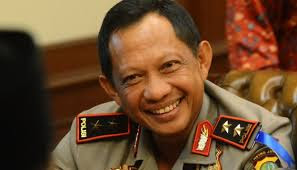
The prospect for deep reforms in Indonesia has always depended on how independent the outsider President Jokowi could be from the country’s sclerotic political party system. His supporters –who detect a masterly Javanese subtlety– have been waiting for a consolidation of his power after which they expect him to deliver on his campaign promises to eliminate graft and patronage. They may have been rewarded this week with the nomination of General Tito Karnavian as National Police Chief. Known for his accomplishments as head of Indonesia’s counter-terrorism agency, Karniawan has been an outspoken proponent of internal reforms and accountability.
“The President’s considerations in choosing Tito Karnavian is to increase the police force’s professionalism to safeguard the public, improve law enforcement, especially regarding extraordinary crimes such as terrorism, drugs and corruption as well as to increase synergy with other law enforcement agencies.” (Jokowi’s spokeperson)
Capturing the assignment was not easy as it has been well known that the former President Megawati, chairwoman of PDIP (the political party that first supported Jokowi back when he first ran for local office as a mayor) supported her former adjutant, Budi Gunawan, the current Vice Chief of Police. Furthermore, Kurniawan was not even on the list of candidates submitted by the National Police Commission headed by Coordinating Minister (Politics, Security, Law) Luhut Pandjaitan, a close confidant of the President. Given the many cases against US businesses where the police have either looked the other way, or been accused of shakedowns, the appointment bodes well for a strengthened rule of law.
Karniawan may remind one of US General David Petraeus, also a battlefield veteran with a PhD. After graduating at the top of his academy class in 1987, Karnavian earned masters degrees in UK and a PhD from Singapore’s Rajaratnam School. Only 51, he made a name for himself early in his career when he apprehended a fugitive Tommy Suharto (son of the former President) accused of murder in 2001. In 2004 he joined (and eventually commanded) the newly created “Densus 88”, a special counter terrorism force that arrested or eliminated hundreds of terrorists such as Noordin Top (thought to be the bomb maker for 2009 Ritz Carlton and JW Marriott attacks). More recently he exposed high-level corruption at the Trade Ministry involving the clearing of goods.
In October 2015, Karnavian gave a major address at an officers school and was paraphrased as saying that police are guilty of “hedonism, consumerism, the enjoyment of glamour and the showing-off of houses and vehicles.” He denounced the prevalence of “unauthorized levies and brokers” in police procedures, and he said there is a need to “impose accountability – because at present the police do not have it.” He said that the main targets for “cleansing and disciplinary operations” should be regional commanders, Criminal Research personnel, traffic police, human resource administrators and logistics managers.”
If, as analysts speculate, Karnavian can bring a new approach to his position, there should be a drop in practices such as one that often affects foreign companies where the police create spurious criminal charges (as was case in the Chevron bioremediation case) either directly or at the request of a third party and offer to drop them for money. Having passed over more senior officers, he may run into opposition. But, he wants to make major changes to recruitment and training, and because of his age, he may have the time needed to do it.
Perhaps because of his strong anti-terrorism credentials there has been little opposition in Parliament. Civil society groups such as the Legal Aid Institute have been more vocal in pointing out alleged abuses in Papua and Jakarta when he was a local commander. Regardless, he should get approved.
The significance of the appointment lies in the President’s defiance of his own party (PDI-P) and perhaps his close aide and backer Luhut Pandjaitan, who once told me “the President has his own mind sometimes”. Together with Golkar’s return to the ruling coalition (reported last month) it signals that Jokowi will be governing more from the instinct for reform that has characterized his leadership since his days as Solo’s mayor. With that as a starting point, prospects for greater legal certainty can only go up.
For those familiar with Indonesian politics Golkar is the party
synonymous with Indonesia’s economic development. More than a just a
political party, Golkar was an amalgamation of various “functional
groups” (military, government bureaucrats, farmer’s organizations, etc.)
that implemented the New Order government’s economic agenda. Golkar was
engineered to be a partner of the government and held a virtual 2/3’s
majority in Parliament for 35 years. In the reform era that followed
President Suharto’s momentous 1998 resignation Golkar has not held the
same sway within the government. Its share of seats in Parliament have
fallen below 20%, although it remains the second largest party. Most of
its members, but not necessarily its leadership, still want to be
partners with the government; its in the party’s DNA. So when chairman
Aburizal Bakrie unilaterally backed Prabowo Subianto’s losing coalition
in 2014 and declared the party to be in the opposition part of Golkar
rebelled. Since then infighting has rendered Golkar ineffective and
currently few Ministerial posts are held by Golkar members. But through a
process of internal reconciliation Golkar has been revived and now
wants back into the government. If Golkar’s (and Bakrie’s) intentions
are purely benign--meaning it will support President Jokowi’s reform
plan--this could be a boon for Indonesia. However, that may not be the
case.
On May 16 Golkar held an extraordinary Congress that brought
together the rival camps and elected Setya Novanto Chairman. Novanto
was recently forced to resign as Speaker of Parliament over secret
recordings that implicate him in an alleged shakedown of Freeport
Indonesia. (Prosecutors are still investigating the case) His successor
Ade Komarrudin ran a close second. Golkar also resurrected its
influential Guidance Board (abandoned after 1998) and elected Bakrie its
chairman. Agung Laksono, a proponent of new leadership and reform who
was Bakrie’s chief rival within Golkar, is not challenging this move.
Other key Golkar posts went to Bakrie supporters who were clearly the
big winners. The Indonesian press reported that Novanto was backed by
Luhut Pandjaitan, a Golkar member who was an early backer of Jokowi and
is currently Coordinating Minister for Politics and Security. On the
other hand Vice President Jusuf Kalla, also a Golkar member, backed
Komaruddin.
A week after the Congress Novanto announced that
Golkar had rescinded its 2014 declaration of support for Prabowo’s
opposition coalition. Novanto said: “Golkar will work with the
government. We will support the programs of the government.” Bakrie
said, “Our expertise is in handling authority – not in mounting
resistance to authority.” On May 24th 6 Golkar leaders including Novanto
and Bakrie met President Jokowi. Although they professed not to be
seeking any ministerial posts the timing was not lost on most observers
who have been hearing rumors of a Cabinet reshuffle for several weeks.
It
may be too early to speculate on what all of this means but several
possible outcomes seem reasonable. Golkar, having observed that
President Jokowi has distanced himself from his patron Megawati, (head
of the PDI-P, still the most popular party) may be positioning itself to
take him in or at least nominate him for reelection in 2019. (One mid
level Golkar official actually said as much.) At a minimum Golkar would
expect to receive one or more ministerial posts. It may also have
bargained for some protection from one or more of the investigations
currently under way of several of its high profile members (including
Bakrie and Novanto).
On paper President Jokowi now has over 60% of
the seats of Parliament in his coalition which should help his
legislative agenda such as the long-awaited tax amnesty bill. He has
artfully watched his rivals bicker among themselves, saying little,
meanwhile pursuing his agenda. There seems to be a steely strength
behind his actions over the first 18 months of his administration.
Golkar may be patting itself on the back for what it may think is its
improved position but the President may see a wolf in sheep’s clothing.
It remains to be seen how much of Jokowi’s reform program Golkar will
embrace.
Just as the Masela Block decision (main topic of last month’s commentary that described a sudden reversal of a decision to build an LNG facility on rather than offshore) spoke volumes to investors about stark divisions within the government over energy policy, the recent revelation by the Corruption Eradication Commission (KPK) of graft within the Supreme Court apparatus will reverberate just as loudly as knowledge spreads outside Indonesia. On April 21 the KPK raided the home of the Supreme Court’s secretary Nurhadi and confiscated $130,000 in several bags. The raid was linked to an ongoing investigation of the Supreme Court bailiff as well as the arrest of a lower court secretary, Edy Nasution, accused of taking a bribe in a case involving a major company. The cash trail led directly from Nasution to Nurhadi. Indonesia’s leading news magazine Tempo reported that according to a former Supreme Court judge Nurhadi ”has the power to intervene with the work of court officials up to the level of judges of the Supreme Court. Nurhadi can push through requests for appeals or case reviews that do not actually meet actual requirements.” In what has often been the pattern Nurhadi, a mid level official, was found to own multiple cars and houses way beyond his means.
Senior Indonesian officials have been quiet so far perhaps because they are waiting for formal charges to be filed. The existence of a court mafia is widely known and local attorneys defending foreign companies and individuals privately confess that they are at a distinct advantage if their adversary brings spurious appeals when they lose. We have seen teachers incarcerated in cases without evidence (JIS) , employees jailed as a result of charges that are civil (Chevron), local debtors avoid paying their foreign creditors by filing capricious counter suits among other tactics. In all of these cases appeals should never been placed on the court’s docket and now we have even more evidence of why: the legal system -- up to and including the highest courts-- can be bought. The Nurhadi case ends the suspicion.
On a recent visit to Indonesia an attorney who often represents foreign companies told me that he is seeing a marked increase in cases in which the police are threatening to bring companies to court if money is not paid. Furthermore complaints to the police are not rejected for lack of evidence. Its all about “funds”. How widespread this extortion is not really known, but it is a troubling development parallel to the corrupting influence of money in the court system.
A strong economy, stable government, and a basic attitude towards reform can sweep plenty of dirt under the rug. But slowing growth (see page 2) and a weakened currency make Indonesia’s dysfunctional legal system stand out more starkly as a barrier to the many open economic policies the current government advocates, especially surrounding foreign investment. Since September of 2015 12 economic restructuring packages have been released, but not one has involved legal reform. The Jokowi government --given the platform on which it was elected in 2014-- should take a serious stand on legal and judicial reform and would do well to undertand its intrinsic importance to the nation’s economic future. Without it the $billions in offshore funds being lured by the new tax amnesty policy will stay there, needed as collateral for loans that lenders demand can only take place in countries with an adequate rule of law. Policy arrows shot at the 7% growth target, dependent more on foreign investment than exports or consumption, will fall short.
It may be that the current administration is waiting for its second term to initiate judicial reforms, but the Nurhadi revelations change the equation. Something needs to be done now and the KPK should not be the only institution rooting out the graft. A major overhaul of the system of judicial and prosecutor appointments, as well as stronger oversight of the work of court employees would be a good start.
As President Obama prepares to receive most of Southeast Asia's
heads of state at the US-ASEAN Summit February 15-16 in Rancho Mirage I am
thinking of a recently fallen friend of AICC, Duane Gingerich, who passed away
last Friday. President Obama had it right several years ago when he coined the
"pivot to Asia" policy, but Duane had already made his own
"pivot "over 40 years ago. Born in a rural region of southeast Iowa
known for its one room schoolhouses and annual youth basketball tournament,
Gingerich made his way to a similarly rural region of Indonesia (also featuring
one room schools) in the late 1960's, through a Mennonite mission. The
hardscrabble lives of the people of East Nusa Tenggara left a deep impression
on him. He once remarked to me: "I had to figure out a useful
way to return".
Upon completing his service mission Duane chose law school as his
return ticket to the people and nation who captured his heart, eventually
helping to build Baker & McKenzie's affiliate office, Hadiputranto &
Hadinoto, into one of Indonesia's top law firms.
|
|
|
Duane and Reti outside their "Semar House"
|
I got to know Duane and his wife Reti towards the
end of his 30-year career in Indonesia. In 2010 they flew from
Jakarta to Yogyakarta to meet me at the airport and welcome me into their
second home in Klaten district. Called "Rumah Semar" (Semar's House)
the house sat a few feet from the rice paddies Duane loved and was filled with
instruments and art. After explaining his love of wayang kulit (shadow theater)
and the wise but vulgar clown servant Semar, we toured several community
projects Duane and Reti had personally supported. The following day he and Reti
departed for Jakarta and I was the sole occupant of a house with a cook and a
driver. By day I would ride in his jeep to visit AICC members in the region and
return home to a satisfying meal. I visited friends in nearby Solo who took me
to meet its dynamic mayor, Joko Widodo, now President. One evening I woke to
the thunderous sound of Mount Merapi's eruption. With six-inch daily ash rains
there was no way to fly to Jakarta where I was scheduled to attend a state
dinner in honor of President Obama's first visit. I called Duane and he simply
said "tidak apa apa" (no worries). Soon I was traveling with his
driver on a 14-hour overland journey to Semarang on Java's north coast and west
to Jakarta. Because of Duane I made the dinner.
Although Duane spent his working life overseeing the preparation
of countless contracts, incorporations, closing documents, and other legal
issues, he never lost his sense of adventure that had first brought him from an
American farm to Indonesia or his pride in his birthplace. During my 2014 visit
he was reviewing catalogs to decide which John Deere tractor he was going to
buy for his Goshen, Indiana home. He wasn't going to necessarily use it in a
field, it was going to be enough for him to ride on it. My right
arm, AICC's Program Coordinator Mini Meraxa, went to school in Jakarta with
Reti. She and Duane advised and celebrated Mini and her husband when their
reverse dream to live in the US came true. Reti, the big city girl and Duane,
the small town country boy were an ideal couple. On trips to the US, it was
Reti that headed to NY; Indiana (and the John Deere) was for Duane.
Since announcing the "pivot to Asia" President Obama,
partially raised in Indonesia, has rarely had time to focus the nation's
attention on the importance of southeast Asia to its future. ISIS and terrorism
overwhelms the narrative, including his last State of the Union speech. As
Curtis Chin, a former ambassador to the ADB commented in a recent Jakarta
Globe op-ed: "Americans could well have benefited from Obama's taking a
moment to underscore how strengthened trade and security relations with the
dynamic economies of Southeast Asia will help the United States meet economic
and security challenges: a pivot to Southeast Asia." Let's hope that this
month President Obama, White House staff and press corps maximize the
importance of the region to America's future and if they do, somewhere Duane
Gingerich will know that his pivot helped pave the way. He was one of our best
native sons.
President Jokowi's visit to the US October 26 and 27, although shortened by the forest fire issue, included a longer than expected bilateral with President Obama, progress on security relations, a substantive unexpected announcement by President Jokowi on TPP ("Indonesia intends to join"), successful sessions with potential and current investors, and roll backs of unnecessary rules for foreign workers as well as possible changes to the negative investment list. Although the ongoing issues of criminalization and incarceration of employees for civil infractions as well as nettlesome energy and mining contract extensions may have been discussed, no follow on announcements were made. The comments of ministers who joined the visit were full of reform rhetoric and combined with the TPP statement one might conclude that Indonesia is moving towards a RBE (rules-based economy). The President did discuss foreign affairs and the economy at Brookings but turned to his ministers repeatedly to answer nettlesome questions. This young President has the strengt

h to delegate but he could send no stronger signal than resolving the case of the Chevron employees that remain incarcerated after courts have decided in their favor as well as making the necessary regulatory changes so international energy and mining companies can safely extend their contracts in a timely fashion facilitating $20-30 billion of potential investments. Such moves would resonate well beyond the extractive sector. But kudos must be given to the overall strong signals the visit generated. I had met Jokowi when he was mayor of Surakarta but he did remember me and our visit to his furniture factory.
Indonesia has released the second of three deregulation/stimulus packages designed to boost a flagging economy and strengthen the exchange rate. The first (released September 10) was primarily an exercise in reducing red tape and regulatory confusion in the trade arena and did not garner a lot of attention and praise, perhaps because its hard to immediately see benefits when you are looking in the regulatory weeds. Darmin Nasution, the Coordinating Economic Affairs Minister admitted, "We issued too many deregulations in the first package and it made us seem to lose focus. Our explanation turned into numbers and people did not get the substance".
However, the package announced Wednesday is more focused and could perk up the ears of investors who --as a whole-- have been moving assets out of Indonesia's capital markets. "We are making (investing in Indonesia) as attractive as possible," said Chief Economics Minister Darmin Nasution, announcing the latest measures along with several other ministers. "We must fix, simplify, make it cheaper."
Here is what you should know about "Installment 2":
- Permit processing times slashed- New measures announced Tuesday included slashing the time taken to process investment permits from at least 8 days to just 3 hours, with processing for permits in mining and geothermal projects in forested areas to be cut from up to 4 years to about 15 days. The 3-hour time frame, however, is for investments over $6.8 million located in designated industrial parks employing over 1,000 people. Although when announced the facility was to be available immediately, officials have backtracked and say it will be launched in mid-October. The number of permits needed for mining exploration and for establishing a business in an industrial economic zone have been cut.
- Tax Reductions- Exporters who deposit foreign exchange revenue in Indonesia or convert it to rupiah will have withholding taxes from the current rate of 20% to 0% depending on maturity. The interest earnings of a one-month dollar-denominated deposit account would now incur a 10 percent income tax; six-month deposits would incur 2.5 percent and for deposit accounts over six months there would be no income tax. The government will remove value-added taxes for ships, planes and trains made in Indonesia. The VAT is also removed for imported aircraft and spare parts.
- Certificates of Deposit- Indonesia's central bank, Bank Indonesia, will reissue three month certificates of deposit and two week repo agreements. "We want to drive [liquidity] from short-term instruments towards longer-term instruments because we're afraid excessive [liquidity] in short-term will create speculation. So we reopen these instruments," said Mirza Adityaswara, BI's senior deputy governor.
- Intervention- Bank Indonesia signaled it will intervene in forward markets for rupiah where it is currently valued above 16,000 to the dollar. The rate as of September 30 was 14,717.
- Import bans on cloves and tires were eliminated. The new trade minister, Thomas Lembong, said "The regulation on tire imports was wrongly targeted as it was aimed at protecting the local wheel industry, while our local tire industry is already world-class as Indonesia is a net exporter.
We will need to see the implementing regulations before a final judgement can be rendered on these policies. But they are a welcome sign of the Jokowi's government intention to make reforms and other changes. It will be interesting to see what will be covered in the next package. There are rumors that Indonesia may bring down corporate tax rates from the current 25% to a level more in line with its ASEAN neighbors or lower. Also, the government may alter the Negative Investment List to allow for more foreign equity. However, other, more wide-reaching reforms to open the economy, change restrictive labor laws, or back away from the mandated value-added (local content requirements) nature of many laws and policies are not yet being talked about. In the end, these deregulation packages may end up being characterized as more minor than major, and Indonesia needs to be performing in the major key. But combined with an earnest approach to building infrastructure-- and getting the allocated budget into the system--the packages should push growth back towards 5% or above.
August 7, 2015
President Jokowi traveled to the Banggai Regency in central Sulawesi this week to inaugurate the $5.8 billion "Pertamina Mega Integrated Project", which is planned to match the upstream production of natural gas with downstream users. The visit follows other forays of the President around the country to jump start other infrastructure projects including: parts of the Trans-Java - a 1,000 kilometer proposed toll road across Java from Merak in Banten, West Java, to Banyuwangi in East Java; the Trans-Sumatran Highway, a 2,508 km north-south road in Sumatra, from Banda Aceh to Bandar Lampung; new power plants that are part the 35,000 gigawatts expected within the next five years; and a 433-km Holtekamp Bridge in Papua.
At Banggai, the President cautioned: "It must be integrated not only on paper but also in its real implementation in the field. This must be truly integrated, incorporating upstream and downstream industrial sectors and connecting gas producers and users. This must be implemented in the petrochemical and LNG business sectors and power plants," said Jokowi.
The huge project symbolizes the dreams of Indonesia's policymakers: for every raw material, there must be integrated downstream uses in the country. One hears the term "integrated" often in discussions and I suppose its natural. We like to think that everything is connected to everything else. When I lived in Indonesia in the 1970's I was always surprised by the natural way many of my Indonesian friends integrated the micro and macro aspects of life. An accident on a road could be instantly connected to a cosmic pattern that had been detected. Integration is harmony, steady-state, stable, values that resonate strongly in Indonesia rather than the dynamic, inherent conflicts of markets.
The meaning of Banggai is not just harmonius upstream and downstream integration, its also about self sufficiency and independence. The gas can be turned into LNG for power as well as ammonia for fertilizer and other uses, lowering the need to import. But in an increasingly interdependent world is this type of integration planning sufficient ? Could it not turn into an ideological imperative, locking Indonesia into policies that isolate rather than integrate it with the region and beyond ?
I think we are at a critical juncture in Jokowi's Presidency. If infrastructure of the kind that lowers logistics costs and helps supply chain integration cannot be accelerated we will only see more nationalist and protectionist policies, further isolating Indonesia's economy, especially given the weaknesses in the rupiah. We rarely hear the voices of Indonesian economists who know their way around international economics, even though some remain in the government. This week two Indonesian economists based in Australia--Arianto A. Patunru and Sjamsu Rahardja-- released an important report via the Lowey Institute, "Trade Protectionism in Indonesia". They observed that in past times bad economic circumstances led to good economic policies but today we are seeing "bad times leading to bad policies". Whether their cautionary voices and those of us outside Indonesia who are her closest friends, alarmed by the protectionist trend, will be heard remains to be seen. Indonesia's needs more "Banggais" and more industrial integration but not at the expense of regional and global intergration. Indonesia's future is not just supply chain connections within its borders but outside them as well. The former will not happen without the latter.
June 30, 2105
The serious Cabinet reshuffle rumors began in June: in Indonesia, they are part of the air one breaths. An underwhelming economic performance would prompt President Jokowi to reshuffle his Cabinet after Lebaran (end of the Muslim fasting month on July 18), especially his economic team. The economy is, given Indonesia's potential, standing still, even though GDP growth hovers at close to 5%. Very little of the dividend from the elimination of energy subsidies has found its way into infrastructure projects, even though the government now has more authority to settle nettlesome land issues. The question is whether the implementation problems are due to incompetent management at the top of ministries-hence the need for a Cabinet change-or something more structural. I am persuaded by the latter. Changing the Cabinet will not necessarily quicken the pace unless the President is persuaded to use more of the power that is vested in his office to bring a greater policy coherence throughout the government and the regions. The import and export ban and value added thesis along with a rupiah-only currency policy are overcompensations for a bureaucracy that has difficulty efficiently delivering the services it was created to deliver. One of the co-chairman of PECC (Pacific Economic Cooperation Council), Jusuf Wanandi, (who since the 1960's has been an influential thought leader) recently said some very important things at a regional economic conference worth repeating here:
"There has been widespread disappointment with the Jokowi government, with economic growth falling to 4.7 percent in the first quarter, a lack of policy coherence keeping investors on the sidelines and bureaucratic inertia causing repeated delays to budget implementation. Investors have been waiting for the right signal to enter Indonesia, but the President should not convey mixed signals. He should do away with the inordinate nationalistic sentiment of the Indonesian Democratic Party of Struggle (PDIP)".
You will read further in this issue of Outlook/Indonesia that the President intends to move quickly in the second half of the year to start spending. You can see moves in this direction by observing the statements of the state-owned construction companies who have announced toll road projects they have won as well as the progress in negotiations over a high speed rail project between Jakarta and Bandung. The stimulus achieved by getting projects underway will certainly help move Indonesia's growth forward as most of it has been from consumption which has been slacking off. But the continuance of populist and protectionist policies (Indonesia just boosted tariffs on a range of food and consumer items), some designed to expand the role of the state in the economy, will likely yield mixed results or worse.
President Jokowi, unlike his fellow political mavericks such as the Governor of Jakarta and the Mayor of Bandung, has chosen to stick by the political party that chose him, PDI-P, a party that remains wedded to a 1950's ideology of state interventionism and a patronage culture (return of favors ) that has been largely eschewed by Indonesia's people. Cabinet changes could make a difference but only if accompanied by more open and transparent economic policies unfettered by the impulse to reward political parties and their benefactors. At least there has been the beneficial influence of the watchdog KPK (anti-corruption commission), press, and NGOs. However, their necessary vigilance has a side effect of paralyzing project implementation by fearful bureaucrats. Let's hope that with or without a Cabinet shuffle the President and his team can reduce the transactional politics that underlies too much of the government's decision-making and get the bureaucracy moving more swiftly. Only then will Indonesia get close to the 6% or higher growth that it is highly capable of achieving.
Indonesia's first President became so frustrated with the "West" that he famously declared " go to hell with your aid". A combination of the Cold War and misjudgments of Soekarno's complex ideology (mixing capitalism and socialism) led the US and other countries down several dead ends that almost capsized relations completely. The late 1950's and early 60's were tough for Indonesia's relations with the US: late to implement economic development aid the US lost critical influence. The US State Department was also obsessed with keeping Indonesia out of the orbit of the Soviet Union and China. Soekarno continuously fought against Western imperialism as well as aid with "strings attached". I heard an echo of Soekarno's rhetoric at two recent events (and their aftermath) that occurred in Indonesia almost simultaneously: The World Economic Forum- East Asia (WEF) and the 60th Anniversary of the Asian African Conference Commemoration (AACC) in Bandung. In his opening address before the AACC President Jokowi said: "Views stating the world's economy can only be resolved by the World Bank, IMF and ADB are outdated and need to be thrown away. . .When the rich nations, which comprise a mere 20 percent of world's population, consume 70 percent of world resources, then global injustice becomes real." These and other similar remarks led to headlines in Jakarta papers such as "West-led Order Obsolete- Jokowi". The immediate background to these statements is, of course, the China-backed Asian Infrastructure Investment Bank (AIIB), an institution that Indonesia's backs wholeheartedly, and America, less so. The US took a direct hit from Finance Minister Bambang Brodjonegoro who commented to reporters right after the WEF: "The US has been very critical, very harsh, about the AIIB and it is unfair . . . The US itself has consistently refused to boost its capital in both the World Bank and the ADB. This has made the situation difficult for us". Jokowi's less direct --but just as clear-- formulation was: "We've urged reform in the global financial architecture to eliminate the domination of a few. The world now needs collective leadership that is just and responsible". The last time I looked Indonesia's own Sri Mulyani, former Finance Minister, held one of the highest positions in the World Bank.
The elevated rhetoric is unfortunate but perhaps to be expected given that most Indonesian Presidents are driven by domestic politics to eschew "western influence and dominance". And perhaps President Jokowi felt it necessary --given the nature of the occasion-- to channel his predecessor's and his party's nationalist viewpoint in Bandung. Both Jokowi and Brodjonegoro are probably right that Asia needs another multilateral lender (especially one focused on infrastructure) but they are wrong to denigrate the institutions --developed at Bretton Woods out of the ashes of the Depression and WWII-- that have helped to lift so much of Indonesia out of poverty. Do these institutions make mistakes and do some of them have their own internal governance issues, yes. But they are not part of some conspiracy to keep countries "down" as Jokowi's comments imply. The US (along with the IMF, World Bank, and Asian Development Bank) should be actively engaged with the AIIB as it develops with the eventual goal of joining. Indeed, contrary to what Minister Brodjonegoro has said, President Obama has already made supportive statements regarding the AIIB. "We're all for it if incorporates strong financial, social and environmental safeguards", he said. However, reforming the world's "financial architecture" seems less important than reforming the bureaucracies in Indonesia and other developing countries that have had severe problems with leakages, "white elephant projects", and other implementation difficulties. These will remain and need to be dealt with as the China-led AIIB gets going.
Indonesia's growth has dropped to below 5%, the rate of foreign investment has dropped, and commodity exports prices have weakened. The President should prioritize economic reform and openness rather than focusing on an untested new institution (AIIB) whose benefits (building infrastructure) will take many years to achieve. Rather than sewing seeds of divisiveness, echoing the nationalism of his predecessor, one might have expected more from Indonesia at these forums. After all Indonesia is a member of the G20 now, it has a seat at the table. It should use its position wisely, not provocatively.
We are starting to see the glimmer of a new strategy for how Indonesia wants to do business and it may have less to with the US dollar.
Foreign exchange ratios have been a hot topic among Indonesia's policy makers ever since June of 2014 when the first news of the end of Fed easing caused financiers to pull money from emerging markets such as Indonesia and the rupiah suffered. After years of trading in the 9,000 range, its been in the 12,500-13,000 for several months now. Even though Finance Minister Brodjonegoro said in January "12,500 is already a good rate to maintain our competitiveness," many companies would disagree. For exporters selling goods priced in dollars who don't need to source components a weaker currency is great news, but for those who need dollars to buy inputs, its been tough going. Increased prices for electricity and higher costs for inputs have forced some exporters out of business.
Concerned over an ongoing current account and trade deficit, policy makers have pursued fiscal programs that -short of currency controls-try to limit foreign exchange transactions. Among these are:
- Mineral export bans, required local smelting and downstream processing
- Beef import bans
- Crude palm oil export tax levied to build a biodiesel industry. The same policy may eventually be applied to coffee and rubber.
- Regulation requiring 50% of reinsurance policies to be paid to a state owned reinsurance company rather than offshore providers.
- Planned tax amnesty to attract offshore funds
- Investment policies promoting "value-added" manufacturing as a priority such as a regulation to ban sale of cell phones not made in Indonesia.
Along with the fiscal import substitution policies we are also seeing other monetary moves to be less dependent on the US dollar for transactions. Although the idea has died, there were rumors that Indonesia would price its energy exports in other currencies not dollars. Bank Indonesia announced last week that as of July 1 all domestic transactions have to be in rupiah. (cash transactions in foreign currencies have been banned since 2011). Eko Yulianto, acting director of money management at Bank Indonesia, said there was demand for at least $6 billion each month for domestic transactions, which the bank hopes to cut once the new regulations are in force. "There are still a lot of transactions using foreign exchange and that has added to pressure on our exchange rate," Yulianto told a briefing on Thursday, adding that companies in textiles, pharmaceuticals, chemicals and the oil and gas sector often used the dollar for domestic payments. "We don't want a dollarized economy so we need to uphold the sovereignty of the rupiah," he said.
Countries that share Indonesia's problems with a strong dollar such as Russia are already aligning themselves accordingly. In a recent bilateral economic meeting Russian Minister of Industry Denis Manturov indicated that the Russian government hopes to localize more fertilizer production in Indonesia and start making payments in rupiah for products it buys from Indonesia. "We have experience in switching to contract payments in national currencies with India, China" said Manturov.
The China-led Asian Infrastructure Investment Bank (AIIB) is slated to bring tens of billions in investment and project finance to Indonesia. Although the bank has yet to launch, 50 countries have agreed to join, including all of Indonesia's major trading partners except the US and Japan. Given China's huge balance of dollars, estimated to be $8 trillion, its unlikely China will be as quick as Russia to meet Indonesia's terms. Thus, we can probably expect that PLN, Indonesia's electricity monopoly, will continue to write power purchase agreements (PPA) with foreign investors in dollars. But that could change, especially China is agreeable to rupiah PPA's.
I personally think Indonesia is overly concerned by a strong dollar and the end of Fed easing. Given the rosy reports from BKPM (the Investment Coordinating Board) Indonesia is attracting large amounts of foreign investments. So its negative current accountpositions may have more to do with the importation of capital goods than US Fed policy. (In fact there was a trade surplus in March due to the drop in oil imports. ) The best path to a stronger rupiah is to promote an open investment regime with fewer strings attached (meaning less nationalism), strengthen the rule of law, and fully implement an infrastructure investment program. If that can be achieved the momentum of the country's economy and youthful population will win out over fluctuations in exchange rates. But meanwhile, US companies should expect Indonesia to make more use of policies that maximize the use of rupiah for transactions.
President Jokowi is likely to travel to the US for his first official visit to Washington in early June. President Obama no doubt wants to hear Indonesia's President describe his country, his plans for its economic future and how the US fits in. What might Jokowi tell President Obama about today's Indonesia? He will no doubt discuss plans for achieving 7-8% growth and creating jobs. He may not say so in so many words but Indonesia's paradigm has become the VAS, Value-Added State.
What are its characteristics?
(Apologies for over simplification of a topic that is actually much more complex than what I set out below.)
1. A VAS welcomes FDI BUT
A VAS welcomes foreign direct investment but wants it to meet priorities established by either its government or legislature. Indonesia does not want foreign investment to create raw materials if there is not the addition of processing or if it believes a local company should be doing it. Indonesia desires to be more than a big market but part of the global supply chain of manufactured goods, producing for other markets, especially within ASEAN.
2. A VAS crafts policies to keep as much currency within the country without going as far as establishing formal currency controls. Indonesia is drafting regulations that will keep insurance premiums within the country. It already has other regulations in place that limit offshore borrowing and prevent Indonesian private equity firms from investing more than 20% of its capital offshore. A VAS finances its debt in local currency when possible.
3. A VAS expands rather than contracts its state-owned sector.
To build the VAS Indonesia's leaders do not fully trust market forces and rely on a large state sector. SOE's (state-owned enterprises) were very important in Indonesia's early years as the private sector was still small. By the late 1990's many SOE's become redundant and unprofitable and some lost their monopoly positions. A wave of privatizations occurred but today they are again being given an out-sized role. For example, four small state-owned reinsurance companies are being merged and given a quasi-monopoly position to receive mandated premiums from companies that previously went offshore. Although the regulation is still under review insurers are highly concerned there may be a loss of capacity and risk leverage which could negatively effect future big ticket investments. Similarly, the 2015 budget includes massive increases to many SOE's who will be tasked with building critical infrastructure.
4. A VAS is paternalist; it desires to be a player not just a referee.
Reform exists and will continue but only as a sidebar to pervasive patronage networks that limit transparency and the rule of law. These networks are stubborn and extend from the private sector to the large bureaucratic state through political parties. Preferences may be given to state-owned firms rather than private companies to import and distribute products. Foreign companies and employees may be singled out for selective prosecution or blamed for holding back the development of local capacity. A non-VAS would see the "other side of the coin"; foreign companies are true partners and are catalysts for the development of local players.
5. A VAS pursues import substitution policies through a combination of import and export bans. A ban on various kinds of beef imports is now employed to boost local cattle production. Raw and semi processed mining products cannot be exported or if so, they have very high duties attached. It has been reported that only cell phones made in Indonesia will be allowed to be sold in the future. The goal is to legislate what the market has not created, more local manufacturing.
6. A VAS intensively credentials foreign workers.
Even though businesses acknowledge a shortage of qualified middle managers, Indonesian officials and some professional associations believe local labor needs protection. Labor certification is reported to be getting more difficult and a new regulation will soon be implemented to require all expatriates employed in the country to pass a basic test of the Indonesian language. Even Indonesian doctors who have earned medical diplomas overseas cannot get these credentials recognized and thus cannot practice if they want to return.
President Obama should ask President Jokowi the following questions: How does the vision of a VAS fit in with regional economic agreements such as APEC, WTO, and the ASEAN Economic Community that lower barriers between the movement of goods, capital, and people? Are there not some internal contradictions?
Commentary by Wayne Forrest
Since taking office in October President Jokowi has not waited for Parliament, using his executive powers to reset Indonesia's course. He is turning out to be savvier then many gave him credit for. 2015 could mark the beginning of a positive new chapter in Indonesia's economic development. Although only a short amount of time has elapsed, Jokowi's legendary problem solving abilities have already been on display. Economically, he has cleared some fiscal space by lowering (and then eliminating) energy subsidies; politically, he has neutralized --at least for now-- the opposition forces (led by rival Prabowo) through clever maneuvering; and diplomatically, he has asserted Indonesia's maritime priorities and need for foreign investment in well received appearances at the APEC, G20 and ASEAN summits. A fractured Parliament has not sat much since October; come January Jokowi will likely bring his own budget forward for its approval. It may be the first true test of his political leadership. He should be able to pass it and redirect upwards of $20 billion to infrastructure, health, education and military hardware. But although things may be going well for Jokowi so far a cautious optimism characterizes the outlook for 2015. Here is my take on the year ahead:
Economic/Financial:
The head of Indonesia's Chamber of Commerce, Suryo Sulisto, told me Jokowi may be Indonesia's most pro-business President yet. One of his first unannounced visits was to BKPM, Indonesia's Investment Coordinating Board. A favorite tactic of his, Jokowi has used them ( blusukan in bahasa) to shake up bureaucracies and rid them of non performers. Knowing how long it can take for investors to get the required licenses and permits, Jokowi is intent on getting every ministry to place a representative in BKPM to truly make it a "one stop shop". If he can pull this off it will be a signature achievement. I give him better than a 50/50 chance.
But investors need more than a responsive bureaucracy. They need to see a healthy economy and an investment climate that's as competitive as India, China, and the rest of ASEAN. Here Jokowi's predilection for serving Indonesia's "interests" could hamper the country's move to join global supply chains for intermediate manufactured products. The cautious part of the optimism will revolve around this central issue.
We can expect final GDP growth to be 5.1% for 2014; 2015 will be better, closer to 5.4%. Jokowi's economic planners have set their 2019 goals and GDP will rise to 7% by then. (Click here to see them in a chart format). This is certainly a reasonable but not overly ambitious goal. In my December meeting with Finance Minister Bambang Brodjonegoro, he predicted 4.5-5% inflation, and a fall in debt to GDP to 30% from 35%. Given the plunge in the rupiah's value his greatest concern is the large amount of dollar denominated private debt. Its clear he is preparing a possible shift to more official, multilateral debt as a backstopping measure. Clearly Indonesia would do anything to avoid another "sovereignty impingement " (i.e. IMF loan). Along with an excellent former Finance Minister (Agus Martowardoyo) at the helm of Indonesia's central bank, Brodjonegoro will maintain the conservative macroeconomic policies that long ago established Indonesia as a primary emerging market.
Jokowi should be able to win Parliamentary approval to increase spending on infrastructure and now that implementing rules are in place for the 2012 Land Law, the government will be able to move much more quickly to clear land for a backlog of power and port projects as well as railroads and toll roads. Less clear is how Jokowi's government will handle other obstacles to creating more value-add manufacturing: rigid labor laws, high minimum wages, high tariffs for many components. More than likely we will see a mixed picture with elements of protectionism in place that run counter to the welcoming hand Jokowi has extended to foreign investors. In its zeal to preserve the rupiah's value Indonesia has become overly concerned with its negative balance of payments. So far, many departments are continuing "keep money at home" policies begun under the previous government that present difficulties to foreign as well as some local companies: inefficient reinsurance rules that redirect premiums to local state-owned companies, possible lowering of foreign equity in banks, maintenance of mineral export bans and demands for local smelters, uneconomic food security policies that raise prices and decrease supply. Jokowi's high publicized efforts to clean up the Energy Ministry and Pertamina --which should enable quicker decisions on new projects--would be of greater usefulness if it were also coupled with wholesale reform of the Attorney General's office and the dropping of criminal charges against Chevron and other companies for essentially civil matters. (See Chevron story on page 4)
At the end of 2015 the full integration of an ASEAN Economic Community (AEC) is supposed to occur but Jokowi has already been quoted -regarding the AEC- that he will look to preserve Indonesia's "interests". Many questions will need to be answered. For example: will Indonesia facilitate work visas for foreign educators, engineers and health professionals or keep barriers in place. For an economy lacking in highly trained educators, engineers, technicians, accountants, aviation mechanics, doctors, and nurses a lack of policy vision regarding AEC (cherry picking only the planks everyone likes) could prove costly in terms of missed opportunities for growth.
Bottom line: an improving macro picture and better fiscal management (elimination of energy subsidies, budget austerity) may win an investment grade rating from S & P and attract back capital market investors but lack of clarity in micro policy will continue to send mixed signals to foreign direct investors.
Politics/Security/Governance
The Presidential campaign of 2014 was the first in Indonesia's history to feature American-style election practices such as issues-oriented TV debates as well as negative campaigning. Never before had Indonesia's electorate seen outright character assassination, false rumors, and outright lies thrown by one candidate's team at the other. The losing candidate, Prabowo, and his supporters were the guiltiest of these practices and they went to great lengths to challenge the results that were closer then had been expected. His coalition (KMP) holds about 60% of seats in Parliament and Jokowi's (KIH) has 40%. But looks can be deceiving. The largest party withing KMP, Golkar, is seriously split, and two others, PD and PPP could easily side with KIH on key votes. The usual script in Indonesia would have the "opposition" groups (especially Golkar, which never wants to be "out of the government") falling basically in line with parties supporting the President in some loose coalition. This hasn't occurred yet causing some I met in December to speculate that something akin to what happened to President Wahid-- whose mandate was removed by a vote in the People's Assembly in 2001 after less than 2 years--may be afoot. If there is to be a serious attempt to unseat Jokowi it will likely be in the form of charging him with overseeing some type of corrupt deal with Chinese communists, a time-honored mantra in Indonesia that reared its ahead during the campaign.
But Indonesia's democracy has evolved since Wahid's time and an impeachment scenario seems unlikely. But like Wahid, Jokowi is basically an outsider whose reform efforts could prove destabilizing to certain members of the commercial, military, and bureaucratic elite. It was direct elections --enabled during Megawati's Presidency and rolled out by her successor SBY-- that brought Jokowi to power. The elite closed ranks at the end of SBY's term --to prevent more "Jokowis"--and passed a law to end them. Right before he left office SBY did one of his patented flip flops and reinstated them by decree after widespread public outrage. In the weeks ahead the issue will come before the legislature who will vote whether to let the decree stand or not. If Jokowi wins this vote (preserving) direct elections, as I believe he will, it will probably signal the end of Prabowo's strong influence over the KMP.
But beyond the election law issue, during 2015 Jokowi will be navigating relations with his own party, PDI-P, whose chairwoman, former President Megawati, must be offered a certain degree of respect. Jokowi is the first President in Indonesia's who does not head his own party (or have a high position within it). The benefit of this is that he is more accountable to the people who elected him at the possible cost of difficulty wielding the power needed to bring about reforms. But I am very encouraged that Jokowi has already overcome PDI-P's natural objection to ending energy subsidies. Another sign of a growing independence is his recent appointment of Luhut Pandjaitan as his Chief of Staff. When I met him in December Luhut told me Jokowi would not hesitate to replace under-performing or corrupt Ministers.
After PDI-P's 19% of seats in Parliament, the next largest faction is Golkar (14%), technically part of the opposition (KMP) coalition. Towards the end of 2014 an insurgent group of younger Golkar cadres failed in their attempt to unseat long time patron and Chairman Aburizal Bakrie, who successfully won a second five year term. Their unhappiness with unilateral moves by Bakrie now looks like a serious rift. Combined with the reports of those who have met Prabowo personally that he seems to lack energy for a concerted opposition effort, Golkar's internal problems should bode well for Jokowi.
Bottom line: expect Jokowi to consolidate a working Parliamentary majority by mid 2015 if not sooner.
Overall outlook: Indonesia's growth trajectory --falsely inflated by high commodity prices (2006-2010) and US Fed easy money policies-- can only move towards 8% (where many experts believe it should be given its large and mostly young population and growing middle class) if its leaders fully embrace a market economy with minimal government intervention and make strong efforts to embrace foreign investment and lower logistics costs. Some but not all of President Jokowi's policies (at least those that we know of at this early stage) will get the nation there. Clearly continuing on with the highly politicized protectionist policies of the past will not. Defining what is a national "interest" will be a key, and hopefully these will help the greatest number of Indonesians attain better, more productive jobs.
|
|
|


